Quick Answer
For most drivers, requesting an ALR hearing is still the smart move. SOAH records obtained under the Texas Public Information Act show that since 2022, 34% of ALR cases have been dismissed, and 42% of defendants have avoided suspension—meaning thousands of people have kept their licenses through the ALR process. In total, 53,090 hearings were held, and 58% ended in suspension, but county outcomes vary sharply (for example, in Harris County, 74% had no suspension).
What are the Chances of an ALR Dismissal in Texas?
Many of our clients ask whether it’s worth going through the ALR process. We believe it is, for reasons we will explain in a bit. However, data obtained via Texas’ Public Information Act show that 34% of defendants have had their cases dismissed since 2022.
The numbers show Harris County residents have the best odds of keeping their licenses. About 74% of the county’s 9,638 cases ended with no suspension. Only Montgomery County’s percentage was higher at 76%, but that county held significantly fewer hearings, at 2,354,
Data: ALR Case Outcomes in Texas
ALR stands for Administrative License Revocation hearing. Because this is an administrative process, the Texas Department of Public Safety has a low burden of proof. However, the state typically doesn’t release the outcomes of ALR hearings.
To learn more about case outcomes, Michael & Associates obtained records from the State Office of Administrative Hearings (SOAH), which show that the success rate is higher than expected – 34% received an “Order Granting Motion to Dismiss,” and 42% managed to avoid a license suspension, which is considered a “win” for the defendant.
Since 2022, 53,090 ALR hearings have been held. Of those, 58% resulted in suspension. Six cases were disqualified.
| Outcome | Number of cases | Percentage |
| Disqualification | 6 | 0% |
| No suspension | 22,447 | 42% |
| Suspension | 30,637 | 58% |
READ MORE: Driver’s license suspension after DWI in Texas
Statistics: Outcomes by County
Harris County had the highest number of cases, but 74% of those cases were resolved without a license suspension. Denton and Tarrant counties had the highest suspension rates at 83% each.
| County | No suspension | Suspension | Total cases | Percentage without suspension |
| Montgomery | 1,789 | 565 | 2,354 | 76% |
| Harris | 7,148 | 2,490 | 9,638 | 74% |
| Galveston | 953 | 367 | 1,320 | 72% |
| Fort Bend | 566 | 288 | 854 | 66% |
| Brazoria | 707 | 402 | 1,109 | 64% |
| El Paso | 357 | 266 | 623 | 57% |
| Dallas | 1,589 | 1,854 | 3,468 | 46% |
| Bexar | 1,588 | 2,881 | 4,469 | 36% |
| Comal | 238 | 626 | 864 | 28% |
| Brazos | 210 | 575 | 785 | 27% |
| Hidalgo | 152 | 468 | 620 | 25% |
| Collin | 588 | 1,753 | 2,341 | 25% |
| Travis | 733 | 2,296 | 3,030 (one disqualification) | 24% |
| Hays | 129 | 456 | 585 | 22% |
| Nueces | 142 | 563 | 705 | 20% |
| Williamson | 217 | 959 | 1,176 | 18% |
| Denton | 481 | 2,301 | 2,873 (one disqualification) | 17% |
| Tarrant | 590 | 2,878 | 3,468 | 17% |
READ MORE: DUI vs. DWI

Statistics: Case Resolutions
About 5% walked away with no suspension because the Texas Department of Public Safety failed to prove their case. Another 21 people were granted an administrative dismissal or DPS default (the DPS representative failed to appear at the hearing).
| Administrative decision | Number | Percentage | Outcome |
| Order granting motion to dismiss | 17,830 | 34% | No suspension |
| Refusal 180 days | 11,568 | 22% | 180-day suspension |
| Failure 90 days breath or blood | 10,384 | 20% | 90-day suspension |
| Defendant default (DPS appears, but defendant does not appear) | 5,392 | 10% | Suspension, varied length |
| Refusal two years | 1,901 | 4% | Two-year suspension |
| Order granting request to waive hearing | 1,757 | 3% | No suspension |
| Negative-denial (This occurs when DPS has failed to prove the issues set out in Texas Transportation Code § 524.035) | 1,578 | 3% | No suspension |
| Negative-denial (This occurs when DPS has failed to prove the issues set out in Texas Transportation Code § 724.042) | 1,257 | 2% | No suspension |
| Failure one year | 814 | 2% | One-year suspension |
| Failure minor | 526 | 1% | 60-120-180 day suspension |
| Boating (under Texas Transportation Code 724) | 29 | .05% | 180-day suspension |
| Boating (Under Texas Transportation Code 524) | 23 | .043% | Varied suspension |
| Administrative dismissal | 11 | .02% | No suspension |
| DPS default | 10 | .018% | No suspension |
| One year affirmative commercial | 6 | .011% | One-year disqualification |
| Negative commercial | 4 | .007% | No suspension |
A negative denial means the defense won the hearing on facts and that DPS did not prove the elements of the case.
One of our ALR attorneys said, “These are the best and hardest types of wins.”
What is an ALR Hearing?
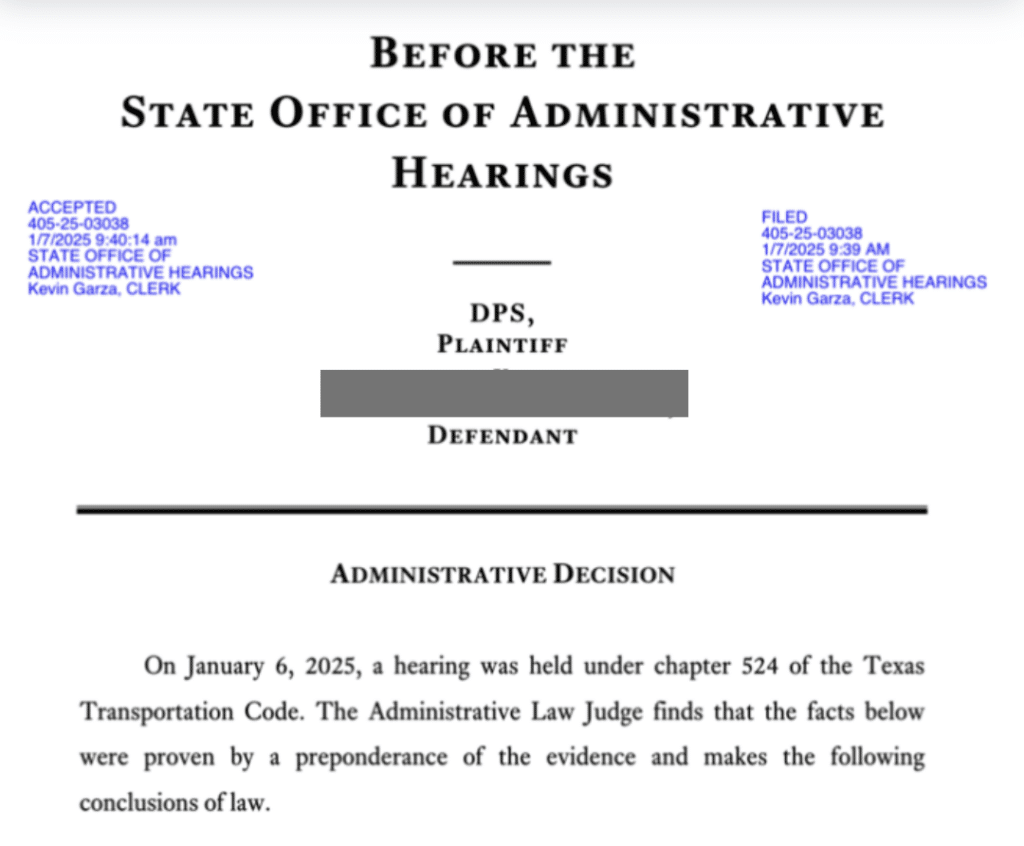
The ALR hearing allows you to fight to keep your driver’s license until your DWI or DUI case is resolved. Even if you don’t “win” your hearing, it offers an opportunity for us to learn valuable details about the case against you.
The ALR is an administrative process that requires the Texas Department of Public Safety to suspend your driver’s license after a DWI arrest. It is unrelated to any criminal license suspension resulting from a DWI conviction.
After you are charged, you have 15 days to request an Administrative License Revocation hearing. The application must be filled out correctly in order to be accepted, and there are details about the case that can be difficult and confusing for a layperson to understand. Once the request has been officially made and accepted, an official ALR hearing will be scheduled usually within 2 to 3 months. If you have hired a lawyer, you do not need to attend the ALR hearing at all. Your lawyer can appear on your behalf.