Jury Duty Eligibility in Texas
Texas Government Code Chapter 62 specifies jury eligibility. It includes:
- Texas Government Code §62.101 (who is qualified or disqualified)
- Texas Government Code §62.102 (who may claim exemption)
- Texas Government Code §62.111 (penalties for ignoring a summons)
You are generally qualified for jury service if you:
- Are 18 years or older
- Are a U.S. citizen
- Are a resident of the county that summoned you
- Have not been convicted of a felony (unless rights have been restored)
- Are mentally and physically capable of serving
If you do not meet these qualifications, you may be legally disqualified.
Disqualification vs. Exemption vs. Excuse
Many people use these terms interchangeably — but Texas law treats them differently.
1. Disqualification
You legally cannot serve. Examples include:
- Not a U.S. citizen
- Not a county resident
- Felony conviction (without restored rights)
- Mental incapacity
If you are disqualified, you should indicate that on your juror qualification form.
2. Statutory Exemption (You Must Claim It)
Under Texas Government Code §62.102, you may claim exemption if you are:
- 75 years of age or older
- A primary caregiver of a child under 12
- A primary caregiver of someone who cannot care for themselves
- A full-time student (high school or college)
- Active-duty military serving away from your home county
- An elected official or certain government employees
- A person who served on a jury within the past 2–3 years (depending on county size)
Exemptions are not automatic — you must request them following the instructions on your summons.
3. Temporary Excuse or Deferral
Even if you don’t qualify for a statutory exemption, courts may excuse or postpone service for hardship.
Common valid excuses include:
- Medical hardship (you must be able to provide a doctor’s note)
- Financial hardship (you will be expected to provide a letter from your employer ot pay stubs showing significant loss of income)
- Non-residency (you must provide proof of your new address)
- Prepaid travel or unavoidable scheduling conflicts (bring travel documents)
The judge will have discretion in these cases. Documentation matters.
What Happens If You Ignore a Jury Summons?
Let me be very clear about this part.
Under Texas Government Code §62.111, ignoring a jury summons is not something the court takes lightly.
If you don’t respond or you simply fail to show up, a judge can:
- Fine you — potentially up to $1,000
- Hold you in contempt of court
- Issue a warrant if you repeatedly ignore the summons
Jury duty isn’t optional. If you genuinely can’t serve, that’s fine — Texas law provides ways to claim an exemption or request an excuse. But you need to follow the proper process and respond to the summons.
Doing nothing is what creates the problem.
How Jury Selection (Voir Dire) Works
Voir dire is the official name for the juror selection process. When you appear, you can still be dismissed during this time.
During voir dire:
Potential jurors are called into a courtroom, where attorneys will ask them some questions. If these lawyers don’t like your answers, you could be removed through peremptory strikes for “for cause.”
'The judge will ask about potential hardships, travel plans, and assess legal qualifications.
You may be dismissed if:
- You cannot be fair and impartial
- You have a clear bias
- You’re unable to follow the law as instructed
- You have a hardship that prevents you from serving
Always answer truthfully. Misrepresenting your situation can result in penalties.
Legal Ways to Reduce Your Chances of Being Selected
You cannot “game” the system — but you can lawfully assert:
- Genuine scheduling conflicts
- Hardship concerns
- Bias or inability to be impartial
- Inability to serve for the expected trial length
Attorneys are looking for jurors who can follow the law and remain neutral. If you cannot, you may be excused.
What to Bring to Jury Duty
If you must report:
- Your jury summons
- Government-issued ID
- Any supporting documentation for an excuse
- Required forms listed on your summons
Courts also require proper attire. Inappropriate clothing may result in being sent home and ordered to return.
Juror Pay in Texas
Texas jurors receive:
- $20 for the first day
- $58 for each additional day
Employers are not required to pay wages during jury service, although many do. Texas employers generally cannot terminate employees for serving on a jury.
Some counties provide:
- Free public transit
- Discounted or validated parking
Policies vary by county.
Does Jury Duty Work Differently by County?
Yes. Larger counties typically offer more options to request one-time deferrals and exemptions, including online portals. Smaller counties and municipalities may require you to contact them by phone or even appear in person at the courthouse.
Always follow the specific instructions listed on your county summons.
How to Request an Exemption or Delay
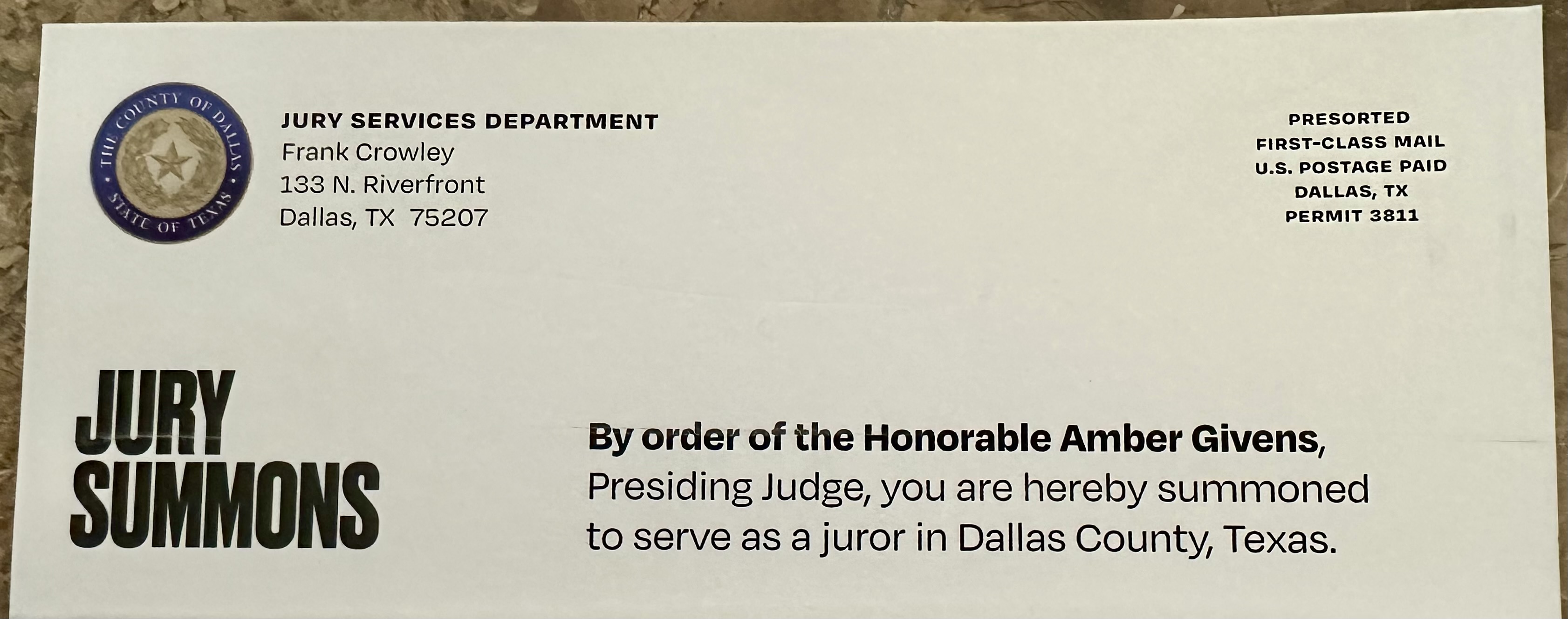
Start by reviewing the summons from top to bottom. There’s usually a juror number and instructions for completing a qualification questionnaire, and in many counties, you can do that online.
If you qualify for an exemption or need to request a delay, follow the instructions on your summons. If you’re claiming that serving will cause hardship, include the documentation — a doctor’s note, employer letter, proof of address, whatever applies to your situation.
Once you submit your request, keep records. Save confirmation emails, screenshots, or copies of anything you send. If there’s ever a question later, you’ll want a record showing you responded properly.
In some situations, the court may require you to appear and explain your circumstances directly to a judge. If that happens, be honest and straightforward.
Also, many counties allow a one-time deferral without documentation — but that’s not universal. The rules vary depending on whether you’re in a larger county like
Dallas or
Harris, or a smaller one. So always rely on the instructions on your summons.
What NOT to Do
To stay within the law:
- Do not ignore the summons.
- Do not lie on qualification forms.
- Do not fake medical conditions.
- Do not intentionally give false answers during voir dire.
Providing false information can result in fines or contempt charges.
Don't be confrontational or intentionally goofy. Showing up in a
prison jumpsuit costume or
faking post-traumatic stress disorder won't necessarily get you excused, and you could end up annoying the judge, who can send you home and order you to return on a different day.
Frequently Asked Questions
Who qualifies for exemption in Texas?
If you’re 75 or older, serve as a primary caregiver for a child or dependent, are enrolled as a full-time student, are on active-duty military service outside your home county, hold certain public offices, or have served on a jury recently, Texas law allows you to claim an exemption through Texas Government Code §62.102. But you must act. This isn’t automatic.
Can I postpone jury duty?
Yes, many Texas counties recognize that you may have plans for a specific date and will allow you to request a one-time deferral without documentation. You must request it through the official portal or by following the instructions on your summons. Keep in mind that you may be immediately assigned a new court date.
What happens if I move after receiving a summons?
If you no longer live in the county that sent you the summons, you may submit proof of new residency. You may need to follow up to ensure that the county received your submission and that you’ve been excused.
Do jurors get paid in Texas?
Yes. $20 for the first day and $58 for each additional day.
Is jury duty mandatory?
Yes. Texas residents who are legally qualified must respond to a summons unless they claim a lawful exemption or excuse.
Bottom Line
There are legal ways to get out of jury duty in Texas — but they have to fall into one of four categories: you’re legally disqualified, you qualify for a statutory exemption, you can show documented hardship, or you’re dismissed during jury selection.
If you truly can’t serve, that’s okay — just handle it the right way. Respond to the summons, follow the instructions, and provide any required documentation. What gets people into trouble isn’t asking to be excused — it’s ignoring the summons or misrepresenting their situation. That’s when penalties can come into play.
About Michael & Associates
Michael & Associates is a Texas-based criminal defense firm that represents clients in all types of misdemeanor and felony cases, including DWI, DUI, drug DWI, marijuana DWI, drug charges, assault and domestic violence, theft, and shoplifting.
Contact us today to schedule a free case review.
Sources: Michael & Associates research, Texas Government Code, Texas Constitution and Statutes, Time Magazine, and FindLaw.com.
Note: This article was written by Ben Michael, Managing Partner of Michael & Associates (Texas Bar Card #24088055). It was originally published on November 19, 2025, and has been reviewed for accuracy by the Michael & Associates research team and the firm's Texas attorneys. This article provides general educational information about Texas jury procedures and is not legal advice. Jury policies vary by county.