By now, you may have noticed (or at least heard) that Pornhub doesn't work in Texas. However, despite many misconceptions, Pornhub is not banned in the state. Instead, Pornhub blocked access to its own website statewide in 2024 after a court upheld a state law requiring adult sites to verify the ages of visitors.
Key Takeaways
- Blocked, but not banned: Pornhub restricted Texas users after the state’s age-verification law passed. Porn remains legal in Texas for adults over 18.
- Privacy concerns: Uploading IDs raises security risks, and VPNs make the law less effective at keeping minors out.
- VPNs are legal: Texans can safely use VPNs to bypass blocked sites. Enforcement targets website owners, not users.
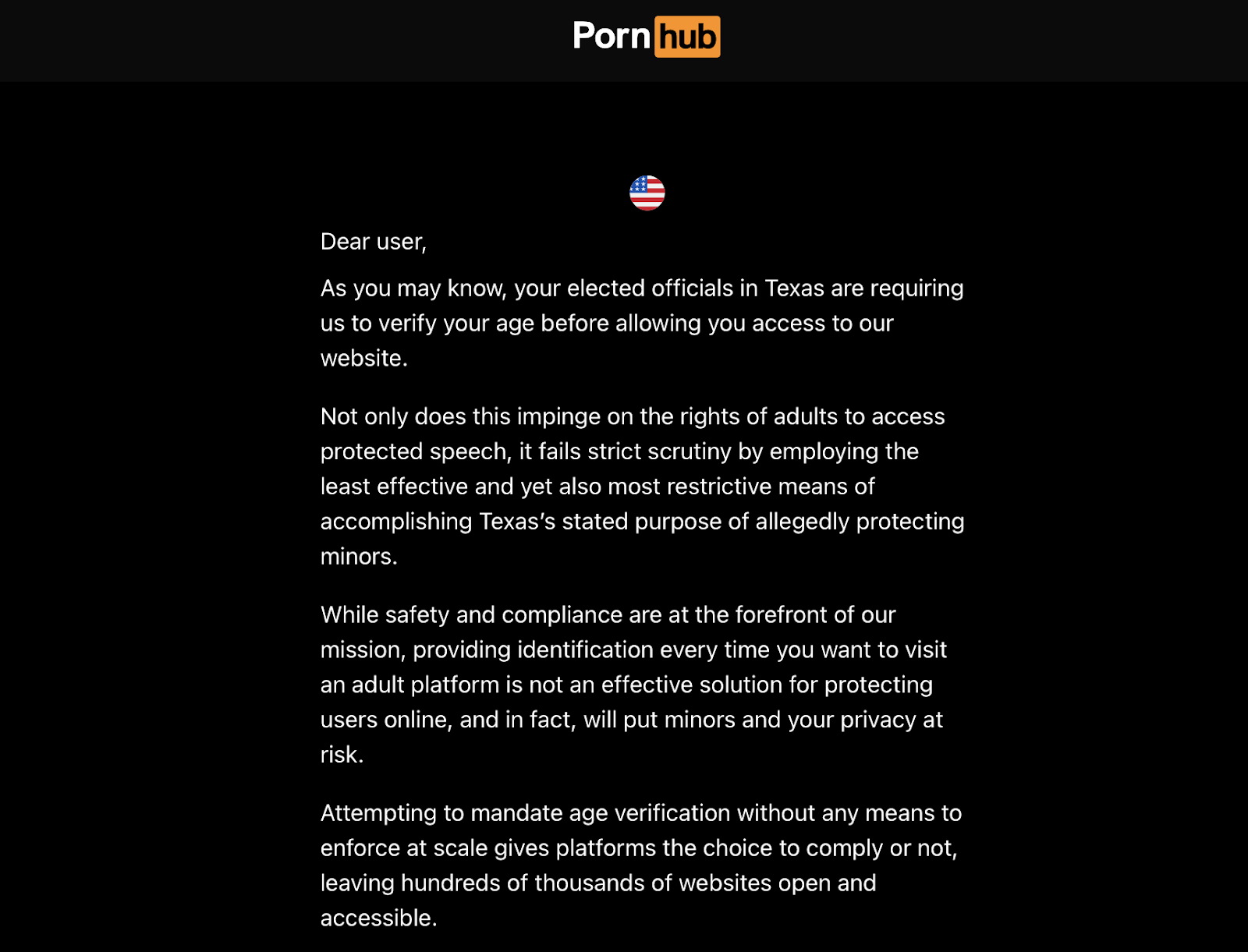
It appears that this law is here to stay. On June 27, 2025, the U.S. Supreme Court upheld it. When Texans attempt to log into Pornhub, access is denied, and this is what you’ll see:
Texas’s Age Verification Requirement
House Bill 1181, which was passed in June 2023, required websites with adult content to verify the age of users before they’re allowed to access the sites. This means that Texans must upload a photo of a government ID to access any website that devotes more than a third of its content to sexual material.
“Oh yeah, that’s real safe,” one person commented. “Lawmakers do not understand technology.”
Pornhub’s parent company, Aylo, has opposed the law, stating that it serves as a smokescreen for conservative lawmakers to restrict adult access to pornography.
“As we’ve seen in other states, such bills have failed to protect minors, by driving users from those few websites which comply,” the company says, “to the hundreds of thousands of websites with far fewer safety measures in place, which do not comply.”
Many Texans have raised concerns about what happens to their data.
“Think about who decides what content is on a website, what kind of process is needed to verify your age, and what other crafty things that information could be used for,” one person commented.
The law not only raises a security issue by requiring users to upload their ID, but it’s also legally unenforceable due to the ready availability of VPNs (virtual private networks). VPN usage surged more than 234% on the day after the law took effect.
Health Warning Requirement
That same law also required porn websites to display a health warning about the dangers of pornography. However, that mandate was overturned by the U.S. Fifth Circuit Court of Appeals.
How Texas’s Law Limits Porn Access
Texas’ law technically doesn’t restrict adults’ access to online pornography, but it does make them consider the risks of posting their personal identification and user data online.
However, opponents of the law argue that this is another attempt by the state’s Legislature to legislate Texans’ personal lives and force all state residents to adhere to the morality codes of a few elected officials. They say that laws like House Bill 1181 try to force Texans to adhere to lawmakers’ personal beliefs by framing them as protections for children.
Many Texas lawmakers have expressed moral objections to pornography. Some object for religious reasons, while others have ethical reasons. They hope that requiring users to provide their government IDs will make consenting adults reconsider visiting these websites.
To that end, the law:
- Makes porn websites liable to minors’ parents if the minors are allowed to access the content
- Requires that any commercial entity distributing more than one-third of sexual material harmful to minors must verify the age of users as 18 or older
- Restricts access to any site that devotes more than a third of its content to sexual material – this is to prevent adult sites from claiming that they’re social media sites
Pornhub’s Response
Pornhub’s response to the law was swift:
“Unfortunately, the Texas law for age verification is ineffective, haphazard, and dangerous. Not only will it not actually protect children, but it will also inevitably reduce content creators’ ability to post and distribute legal adult content and directly impact their ability to share the artistic messages they want to convey with it.”
Adult websites argue that requiring government ID information deters legal users. PornHub argues that device-based age-verification systems (in which age is verified at the time you purchase your device or through manually submitting information to your service provider) are safer and more effective.
The Law’s Legal Challenges
When presenting arguments to the Supreme Court, lawyers representing Texas stated that the law’s opponents had failed to demonstrate a single person whose rights were “chilled” by it.
Texas Attorney General Ken Paxton called the Supreme Court’s ruling a “major victory for children, parents, and the ability of states to protect minors from the damaging effects of online pornography.”
“Companies have no right to expose children to pornography and must institute reasonable age verification measures. I will continue to enforce the law against any organization that refuses to take the necessary steps to protect minors from explicit materials,” he said in a written statement.
When Pornhub initially blocked Texans’ access in 2024, Paxton called it a win for Texas.
“Pornhub has now disabled its website in Texas. Sites like Pornhub are on the run because Texas has a law that aims to prevent them from showing harmful, obscene material to children. In Texas, companies cannot get away with showing porn to children. If they don’t want to comply, they should leave Texas.”
In addition to Pornhub’s arguments, the law was challenged by the American Civil Liberties Union (ACLU), the Free Speech Coalition, and other groups, which argued that the bill exposes users to the potential for identity theft, tracking, or extortion. The legal challenges also noted that the law isn’t particularly effective because it does not require age verification by social media sites (including X, formerly Twitter) or search engines, where pornography can be rampant.
The Supreme Court’s 6-3 ruling was split along ideological lines, with justices saying that the law only “incidentally” burdened the protected speech of adults. Therefore, the law was not subject to strict scrutiny.
Justice Clarence Thomas wrote in the majority opinion: “Because H. B. 1181 simply requires proof of age to access content that is obscene to minors, it does not directly regulate adults’ protected speech. Adults have the right to access speech obscene only to minors.”
The three dissenters, Justices Sonia Sotomayor, Elena Kagan, and Ketanji Brown Jackson, argued that Texas’s law impinged on free speech because it was intended for adults, not minors.
How to Access Blocked Websites in Texas
No matter what the law states, every Texan has access to a VPN. This service enables you to establish a secure and private internet connection to another network. It encrypts your internet traffic and routes it through a server located in a different part of the world.
By encrypting your data, the VPN protects your online activities from being monitored by your Internet Service Provider (ISP), government agencies, or even hackers.
VPNs mask your IP address and enable you to access websites or services that may be restricted in your region, including those that are blocked.
There are free VPNs, paid subscriptions, and you can even create one yourself, but an effective VPN can help cover up much of your digital footprint, including:
- Your IP address
- Your location
- Any websites you visit
- App usage
- Time spent on websites and apps
- Files downloaded or uploaded
Is It Legal to Use a VPN to Watch Porn?
Use of VPN services is legal in Texas. There is no problem with VPN usage unless you’re using them to do something illegal, like view child pornography.
Porn is legal for anyone over age 18, so it is within adults’ rights to use VPNs to access Pornhub (or other blocked websites).
Pro tip: It’s important to note that we do not advocate using a VPN to access blocked content if you are under 18. If you get caught, there could be legal consequences.
How is Texas’ Porn Law Enforced?
Texas’s age-verification law bypasses criminal enforcement by placing the burden of age verification on the websites and their owners.
Because there is technically no way for law enforcement to monitor Texans’ VPN use and arrest citizens for noncompliance, the law places the burden of enforcement on the websites themselves. The site is required to pay civil penalties if it fails to comply with the regulations. This makes companies liable to parents who find their children accessing the sites.
Fines are up to $10,000 per violation and could be raised to up to $250,000 per subsequent violation.
Frequently Asked Questions
Q. Is Pornhub banned in Texas?
No. Pornhub is not banned in Texas. The site voluntarily blocked access in 2024 due to House Bill 1181, which requires adult websites to verify users’ ages before granting access.
Q. What does House Bill 1181 require for adult websites?
HB 1181 mandates that websites with more than one-third adult content must verify that all users are at least 18, usually by uploading a government-issued ID. Websites that fail to comply can face civil penalties.
Q. Can Texans legally use a VPN to access blocked sites?
Yes. VPNs are legal in Texas and allow adults over 18 to access sites like Pornhub, bypassing voluntary blocks without breaking the law.
Q. Who is responsible for enforcing age verification laws in Texas?
The enforcement burden falls on website operators. Texans themselves are not penalized for accessing adult content, but companies that fail to comply may face fines of up to $10,000 per violation.
Q. Does Texas’s age verification law violate free speech rights?
According to the U.S. Supreme Court, the law does not directly regulate adults’ protected speech. It only requires proof of age to access certain content. However, dissenting justices argued it could burden free speech for adults.